In Part 1, we covered the workhorses of foam fabrication — polyethylene, polyurethane, and crosslinked polyethylene — and how to tell them apart. But those three don’t cover every job. A second tier of materials shows up constantly in protective packaging, automotive interiors, and equipment cases, and specifying within it is where a lot of cost and performance gets decided.
Expanded polystyrene (EPS), expanded polypropylene (EPP), and expanded polyethylene (EPE) are the three foams Keystone fabricates most often outside the main polyethylene, polyurethane, and crosslink families. EPS is the low-cost, high-insulation workhorse. EPP and EPE are close cousins that bridge the gap between EPS and crosslinked PE — much of the durability, at a lighter weight.
Specifying the wrong one usually shows up the same way: a part that survives the first drop test and fails the fifth, a case liner that scuffs a Class A surface, or an insert that costs three times what the application actually required.
Here’s how these three materials differ, and where each one earns its place.
Expanded Polystyrene (EPS)
EPS is the material most people call “styrofoam.” That’s a misnomer worth correcting, because it causes real specification confusion. Styrofoam is a brand — specifically, DuPont’s brand of extruded polystyrene (XPS) building insulation, a different material made by a different process. Styrofoam is to EPS what Kleenex is to tissue: a brand name that stuck to a whole category. The white foam in your shipping cartons is EPS.
EPS is a lightweight, rigid, closed-cell material available in a range of densities, with higher densities providing greater strength. It’s the most economically priced foam in the protective packaging category. EPS is most often molded into shape, but Keystone also fabricates it in-house on the waterjet, and works with a local partner who pours the material — keeping freight cost low on a product where you’d otherwise be paying to ship air.
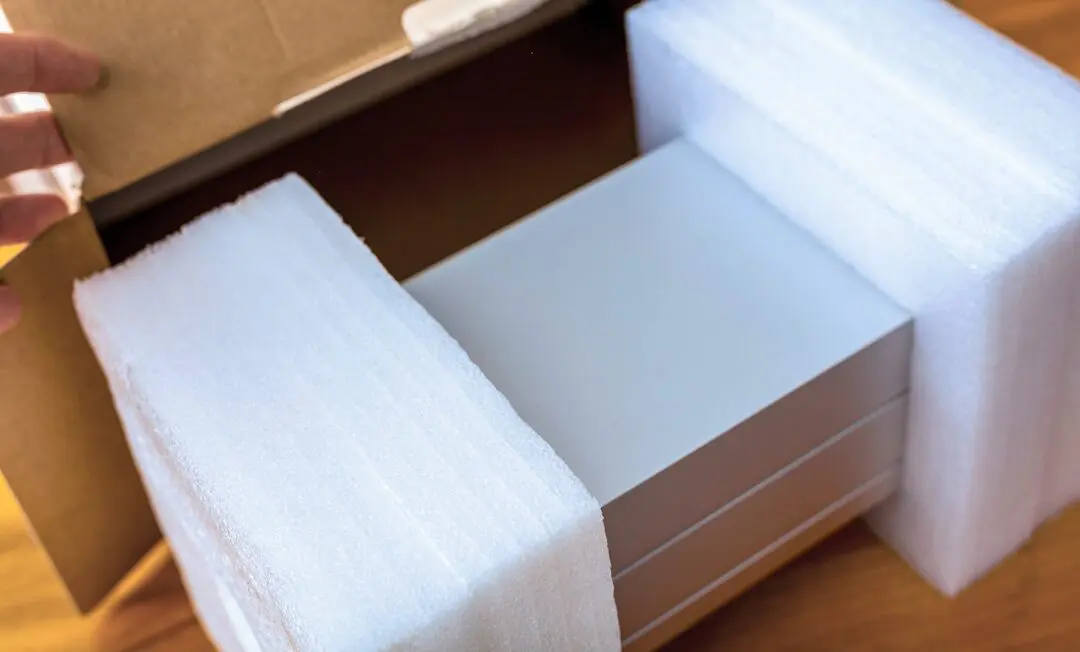
The dominant use is packaging: corner protectors, and frames for windows, doors, and cabinet doors. Think of the foam cradling a new television in its carton — that’s EPS. It’s also a strong insulator, carrying a higher R-value than the polyethylene foams Keystone stocks; rigid EPS board typically delivers roughly R-3.6 to R-4.0 per inch and holds that value over the long term with no thermal drift. That’s why Keystone has cut EPS panels for panel coolers that keep a load hot or cold across a multi-day shipment.
EPS has one clear limitation, and it drives most substitutions away from it: brittleness. It’s so firm that it becomes brittle, and a hard enough drop will crack or break it. That makes EPS a single-use or few-use material — which is exactly why Keystone often steers customers toward polyethylene or the two foams below when a part has to survive repeated handling.
Expanded Polypropylene (EPP)
EPP is a beaded, lightweight foam that sits between EPS and crosslinked PE — much more durable than EPS, with performance that leans toward crosslink. Of this group, EPP is the performance leader: the polypropylene base gives it the highest impact resistance and energy absorption, and it recovers its shape after repeated compression rather than crushing permanently the way EPS does. It also holds up better across temperature swings and resists a wide range of chemicals.
That resilience is why EPP is the foam behind firm, structural automotive interior components — the door panels, ceiling panels, and armrests where a hard, dimensionally stable part is required. It’s also non-abrasive, making it safe against Class A surfaces, and it carries much of EPS’s insulating value, just at a premium price. Where EPS is a one-trip material, EPP is a long-term, multi-use one.
Expanded Polyethylene (EPE)
EPE is expanded polyethylene, and it should not be confused with standard PE — the two perform very differently. Like EPP, it’s a beaded material that looks like EPS but performs far more like crosslink. Made from low-density polyethylene, EPE is the softer, more flexible member of the pair, with a high rebound that makes it excellent at cushioning and surface protection. It shares EPP’s core strengths — lightweight, non-abrasive, moisture and chemical resistant — and is particularly well suited to protecting finished goods and Class A screens, where a cheaper foam would scuff a cosmetic surface over repeated insertion cycles.
Because polyethylene is the more economical resin, EPE tends to be the choice for higher-volume protective packaging, while EPP is reserved for the higher-stress structural work. Like EPP, EPE is also a durable, multi-use foam that carries EPS-style insulation at a premium.
One fabrication note that applies to both: EPP and EPE are difficult to cut cleanly with standard blades, which historically pushed them toward molded production. Keystone’s waterjet and newer V-blade tooling have opened up clean fabrication of both materials — including newly acquired automotive work. Both are also used in defense: mil-spec requirements leave only a narrow window for them in most applications, but they’re a strong fit for uses like drone cases.
Side-by-Side Comparison
| Property | EPS | EPP | EPE |
| Base Polymer | Polystyrene | Polypropylene | Low-density polyethylene |
| Cell Structure | Closed-cell | Closed-cell | Closed-cell |
| Durability | Low — brittle, cracks under repeated impact | Highest — multi-impact, recovers shape | High — multi-impact, softer |
| Service Life | Single-use / few uses | Multi-use | Multi-use |
| Relative Firmness | Rigid | Firm, structural | Softer, flexible, high rebound |
| Surface Safety | Can crack and shed | Non-abrasive, Class A safe | Non-abrasive, Class A safe |
| Insulation | Excellent (R-3.6 to R-4.0 per inch) | EPS-like, at a premium | EPS-like, at a premium |
| Relative Cost | Lowest | Premium (higher-performance) | Mid — more economical than EPP |
| Fabrication | Molded; waterjet-cut in-house | Waterjet, V-blade | Waterjet, V-blade |
| Available at Keystone | Yes | Yes | Yes |
Matching Foam Material to Application
Three questions narrow the decision quickly:
1. How many impacts does the part need to survive?
If the answer is one, EPS is almost always the most economical correct choice. If it’s dozens or hundreds, EPS will crack — and EPP or EPE is the right specification.
2. Structural, or cushioning?
If the part is a firm, load-bearing component — an automotive panel or armrest — EPP’s rigidity and impact recovery make it the pick. If the job is protecting a finished surface or a fragile product, EPE’s softer, higher-rebound cushioning fits better.
3. Is thermal performance a requirement or a bonus?
If insulation is the primary function — cold-chain shipping, panel coolers, thermal packaging — EPS delivers the highest R-value per dollar in this group. If insulation is secondary to durability, the premium for EPP or EPE buys performance you’ll actually use.
Looking for a foam fabrication partner you can trust?
Keystone Foam has fabricated EPS, EPP, EPE, and the full polyolefin and polyurethane range for more than 40 years across medical, industrial, military, and packaging applications. Whether the requirement is a single-use EPS corner protector or a multi-impact EPP automotive panel with Class A surface requirements, Keystone has the in-stock material selection, engineering and fabrication capabilities, and application experience to help get it right the first time.
__
FAQs
Is EPS the same thing as Styrofoam?
No. EPS (expanded polystyrene) is the white foam used in protective packaging and insulation panels. Styrofoam is DuPont’s trademark for extruded polystyrene (XPS) building insulation — a different material made by a different process. The names get used interchangeably in casual conversation, but they shouldn’t be on a spec sheet.
What’s the difference between EPP and EPE?
Both are beaded, lightweight, non-abrasive foams that outlast EPS. The difference is the base polymer: EPP (polypropylene) is firmer, with the highest impact resistance of the group, which suits structural automotive components; EPE (polyethylene) is softer and more economical, which suits cushioning and high-volume surface protection.
Why choose EPP or EPE over EPS?
Durability. EPS is brittle and cracks under repeated impact, limiting it to single- or few-use applications. EPP and EPE absorb repeated impacts without permanent deformation and are non-abrasive against Class A surfaces, making them the standard for reusable packaging, medical equipment cases, and drone cases.
Can EPP and EPE be fabricated, or do they have to be molded?
Both. These materials are hard to cut cleanly with standard blades, which historically pushed them toward molding. Waterjet cutting and newer V-blade tooling have made fabricated EPP and EPE parts practical.
Does Keystone Foam stock all of these materials?
Yes. Keystone fabricates EPS, EPP, and EPE alongside polyethylene (PE), polyurethane (PU), crosslinked polyethylene (XLPE), viscoelastic foam, and other specialty materials. Contact Keystone to discuss your specific application.